

Discover the Advantages of Using a 316 Stainless Steel Ball Valve in Industrial Applications
- 2026-01-08 12:00:00
- admin
- NO COMMENTS


Common Valve Challenges in Harsh Environments
Industrial facilities pose a brutal environment for valves. Steaming acids, abrasive slurries, and high-pressure gases push ordinary materials to their limits. Ball valves – favored for their quick quarter-turn shutoff and tight sealing – can suffer damage if they’re not built with resilient components. For example, pressure shocks in a poorly controlled pipeline can trigger water hammer – a pressure wave that slams into valves. The impact of such pressure surges can deform a valve’s ball or dislodge its seat: pressure spike → mechanical stress → valve seat distortion → leakage.
Corrosion remains the arch-nemesis. Many chemicals actively attack valve materials. Chloride-rich solutions, for instance, eat away at standard stainless steels like 304, leaving behind crater-like pits. Once pitting begins, it’s a one-way road to leaks as the ball and sealing surfaces become rough and uneven. Engineers on-site often describe finding valve internals “chewed up” after only months of service in brine or acid duty. Scaling and mineral deposits pose another issue, especially in high-temperature steam lines. Repeated cycles of heating and cooling cause thermal expansion and contraction in valve components – if the materials can’t handle it, threads may loosen or gaskets extrude, and soon a once-tight valve begins to seep.
How a 316 Stainless Steel Ball Valve Works
To appreciate why a 316 stainless steel ball valve excels in these scenarios, it helps to understand its construction. A ball valve controls flow using a polished spherical plug (the ball) with a bore drilled through its center. In the open position, the bore aligns with the pipeline, allowing fluid to flow freely. Rotate the ball 90° via the stem (by a handle or actuator), and the solid part of the sphere swings into place, blocking flow completely. This simple quarter-turn mechanism provides fast, positive shutoff. Importantly, many ball valves are full-port, meaning the bore is the same diameter as the pipe, so there’s no flow restriction when open.
In a 316 stainless steel design, all the wetted parts – the ball, body, and often the stem – are made of SS316 (an alloy of steel with roughly 16–18% chromium, 10–14% nickel, and 2% molybdenum). This material choice is pivotal. The chromium in stainless steel forms a thin passive oxide layer on the surface that prevents rust in the first place. Meanwhile, the added molybdenum in 316 is a game-changer for resisting chlorides and chemical attack. (Chloride ions are notorious for breaching the protective oxide on lesser grades like 304, but the Mo in 316 dramatically improves pitting resistance.) As a result, a 316 ball valve submerged in saltwater or acid will endure much longer than the same valve in 304 or carbon steel.


Inside the valve, the seals and seats are equally critical. Most 316 stainless steel ball valves use PTFE (Teflon) seats – a polymer famous for its chemical inertness and low friction. PTFE seats conform snugly around the metal ball, ensuring a tight seal even as the ball rotates, while shrugging off aggressive chemicals that would chew up lesser materials. For the stem packing and O-rings, engineers often select FKM, better known by the trade name Viton. FKM is a fluoroelastomer that holds up against oils, solvents, and high heat; it retains its elasticity at temperatures where ordinary nitrile rubber would scorch. With PTFE and FKM teaming up alongside 316 stainless steel, the valve’s internal components form a robust barrier to leaks. The result is a valve that turns smoothly and seals reliably, even when confronted with caustic fluids or elevated temperatures.

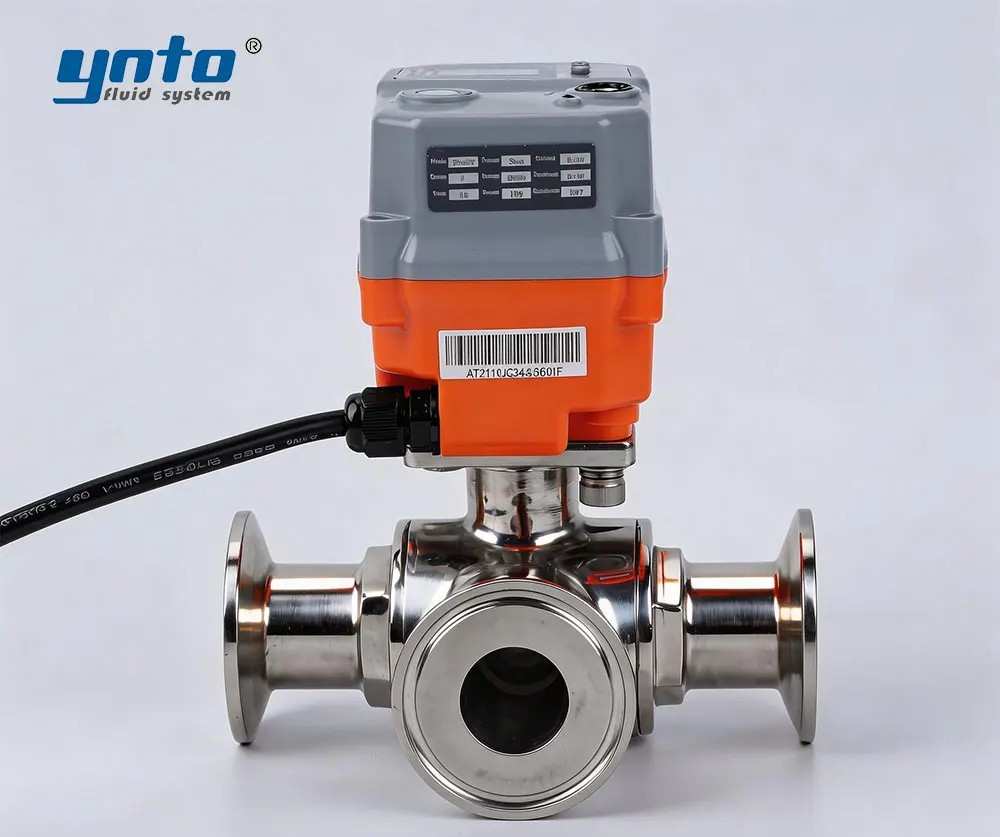
A stainless steel three-way ball valve with flanged ends. Rugged 316 valves like this can handle corrosive media and high pressures. In industrial pipelines, such stainless steel valves provide reliable flow control under harsh conditions.
Not only do 316 stainless steel ball valves resist chemical attack, but they are also built to handle pressure and heat. A standard brass or PVC valve might soften or warp if subjected to steam service or high pressures, but a 316 stainless valve is purpose-built for such extremes (though in ultra-high-pressure cases, alloy steels may be used for their higher strength at the expense of corrosion resistance). These valves can operate at temperatures beyond 200°C and at hundreds of bar of pressure – conditions that would warp a brass valve or burst a plastic one. The metal’s strength, combined with robust design features like a blowout-proof stem, means a 316 valve stays intact and sealed even when pressure spikes occur. Many designs are also fire-safe (meeting API 607 fire test requirements), adding an extra layer of safety for flammable fluids.
Advantages of 316 Stainless Steel in Aggressive Applications
Given the gauntlet of stresses in industrial service, the choice of valve material often comes down to performance versus cost. Here, 316 stainless steel shines in several key ways:
· Unmatched Corrosion Resistance: 316 stainless steel withstands acids, alkalis, and saltwater that would rapidly destroy other metals. In a seawater desalination plant, for example, valves see continuous exposure to concentrated brine. A 304 or cast iron valve in that environment might be speckled with rust after just a few weeks. Switch to 316, and the valve remains virtually unaffected by saltwater even after years of service. Offshore platforms and marine facilities likewise insist on 316 steel for critical valves to avoid rapid corrosion in seawater environments.
· High Temperature and Pressure Capability: 316 stainless steel valves are built to handle high heat and pressure. They can operate at temperatures beyond 200°C and at hundreds of bar – far beyond what brass or PVC could tolerate. The metal’s tensile strength, combined with smart engineering (e.g. heavy wall thickness and secure stem retention), keeps the valve safe and leak-tight under pressure surges. Many 316 valves are also designed as fire-safe, meeting API 607 standards to remain sealed during a fire. This makes them suitable for critical hydrocarbon service where safety compliance is a must.
· 
· Versatility from Clean Rooms to Oil Fields: The same 316 stainless steel ball valve that survives acid onslaughts can also meet the purity demands of pharmaceutical factories. In high-purity applications, any contamination can spoil a batch or shut down production. Grade 316 is prized not only for its broad chemical resistance but also for its smooth, easy-to-clean surface. The low-carbon variant 316L is often used in these settings – its reduced carbon content prevents carbide precipitation during welding, preserving corrosion resistance in weld zones. A 1/2 316 stainless steel ball valve installed on a biotech fermenter’s CIP line can be steamed out or autoclaved repeatedly without introducing rust or metallic contamination. Valve manufacturers supply 316L valves polished to mirror finishes and compliant with stringent sanitary standards (FDA regulations, 3-A dairy standards, EHEDG guidelines, and ASME BPE specifications for biotech equipment).
Crucially, 316 stainless valves can be customized to different configurations without sacrificing their core benefits. For instance, if space is tight, a compact 1 2 stainless steel 316 mini ball valve fxm npt (indicating a 1/2-inch miniature valve with female × male NPT threads) can be used to shut off flow in a small-diameter line – you still get the full corrosion resistance of 316 in a tiny package. On the other end of the spectrum, large 8-inch flanged ball valves in a chemical plant might use 316 for all internal wetted parts, yet be fitted with pneumatic or electric actuators for ease of operation. The seats and seals in a 316 valve can also be tailored: besides PTFE, options like reinforced Teflon (RTFE) or PEEK seats are available for higher temperatures, and elastomers like EPDM or FKM can be chosen based on the fluid. Through all these variations, the common thread is the 316 stainless steel itself, providing a baseline of durability and corrosion resistance that other valve materials struggle to match.
Integrating 316 Ball Valves into Your System
Among the variety of valve styles in industry (gate, globe, diaphragm valve, etc.), ball valves often stand out for their compact size and low pressure drop when open – especially when built from robust 316 stainless steel. When upgrading an installation or designing new equipment, engineers and procurement specialists consider not just the valve’s materials but also how it will integrate into the system. One big advantage of 316 stainless steel ball valves is their wide availability in standardized sizes and designs. They can be found in all common pipe diameters and in one-piece, two-piece, or three-piece body configurations, making it easy to match a valve to any space or maintenance requirement.


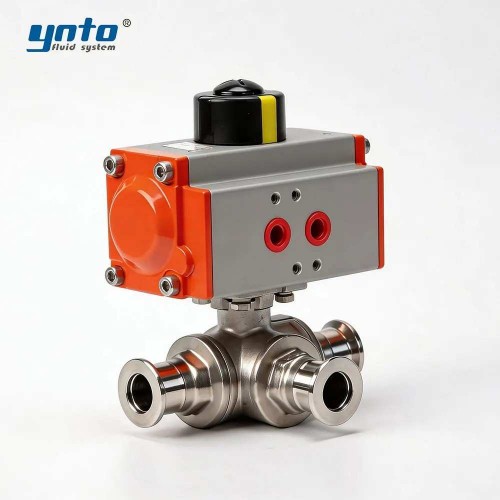
Moreover, automation is straightforward. Most 316 ball valves have a mounting pad drilled to ISO 5211 standards, allowing a direct mount of an actuator. If a plant needs remote or automated control, you can bolt on an electric actuator to create an electric valve that opens or closes at the push of a button from the control room. Alternatively, a pneumatic actuator can be used to drive the valve with air pressure – a common choice for a fail-safe system in chemical plants (air pressure can slam the valve shut quickly in an emergency). In either case, the valve’s core performance – corrosion resistance and tight shutoff – remains the same, while the actuator adds convenience and control. Many valve assemblies also incorporate feedback devices like limit switches and positioners for precise flow regulation as part of an integrated process control system.
When specifying a 316 stainless valve, verify its design and testing certifications. For critical service, for instance, look for valves that have been pressure-tested to API 598 standards (ensuring zero leakage) and are rated for the appropriate ANSI or DIN pressure class.

Conclusion
From the cacophony of a high-pressure reactor hall to the sterile stillness of a pharmaceutical clean room, 316 stainless steel ball valves prove their worth as dependable workhorses. Their robust construction and superior materials solve the on-site problems that plague lesser valves – whether it’s halting a dangerous leak on a corroded chemical line or preserving the purity of a food-grade process. Ultimately, the corrosion resistance, strength at temperature, and reliability of 316 stainless steel translate to fewer shutdowns, lower maintenance costs, and safer operations. When a single valve failure can spell disaster, investing in a high-quality 316 stainless steel ball valve isn’t just an option – it’s a necessity.

.png?imageMogr2/format/webp)
- 2026-09-30 08:25:23
- 2026-09-28 10:28:43
- 2026-09-21 15:23:44