

BSP Threaded Electric Valves in Industrial Applications
- 2026-01-16 12:00:00
- admin
- NO COMMENTS
Introduction: I walk through a steaming clean-in-place (CIP) system in a food processing plant, clipboard in hand. A stainless steel BSP electric valve on the caustic rinse line is cycling erratically. Each time the CIP pump surges, the valve’s electric actuator twitches, reacting to pressure fluctuations. A subtle vibration hums through the piping as the valve modulates, and a telltale drop of caustic appears at a threaded joint – likely a sign of aging PTFE tape on the BSP fittings. With 15 years of experience as a valve process engineer, I’ve seen these issues before. A pressure spike (cause) can drive an actuator past its setpoint (effect), which in turn triggers oscillation and mechanical stress on the valve and seals (impact). In this case, the 316L stainless valve body itself is sound – built for corrosion resistance – but the seal maintenance is overdue. As I note the sticking actuator and minor leak, I start diagnosing: Is it a control signal tuning issue, or perhaps the seat material swelling due to temperature? Real-world valve work is rarely “set and forget.” It’s a cycle of observation, analysis, and adjustment in an ongoing quest for reliability.

Troubleshooting Valve Performance on the Plant Floor
In an industrial setting, valves are not just abstract components; they’re tangible parts of the process that talk to the engineer through their behavior. In our CIP scenario, the electric valve’s rapid oscillation during a flow surge told me the PID controller might be too aggressive – essentially overcorrecting, causing the actuator to hunt. The cause-effect-impact chain became clear: an oversized valve in a low-flow condition (cause) was operating near the seat’s crack-open point, leading to continuous minor opening/closing (effect) which resulted in undue wear on the actuator gears (impact) and a jittery flow control. During inspection, I also found the actuator’s limit switch slightly out of calibration; it occasionally read “closed” before the plug fully seated. This false feedback (cause) left the valve slightly ajar (effect), contributing to the pressure oscillations in the CIP line (impact). Small details like a mis-set limit switch or a sticky solenoid pilot can have outsized effects.
An explosion-proof solenoid valve assembly used as a pilot for pneumatic actuators. Tiny pilot valves control air flow to main actuators; if clogged or worn, they cause sluggish or failed valve responses. In one case at a chemical plant, a pilot solenoid valve feeding a pneumatic valve actuator started to stick due to fine sediment. The cause was traced to inadequate filtration; the effect was a delayed actuator response and the impact was an oscillating pressure in a reactor jacket that should have been steady. We removed the pilot valve, cleaned out polymer grit deposits, and the pneumatic actuator sprang back to its crisp operation. The lesson was clear: seemingly minor components (like a pilot solenoid) can trigger a cascade of control issues. As an engineer, I’ve learned to trust what the system “feels” like – a slight timing delay, a different vibration frequency, or a temperature change can all be clues pointing to a root cause in a valve’s performance.

Selecting the Right Valve Type for Each Application
When resolving these issues, I often step back and evaluate if the valve type is optimal for the job. Industrial processes use a range of valve types – each with its own quirks and strengths:
· Solenoid Valves: Quick-acting and compact, solenoids are fantastic for on-off tasks and as pilots for larger valves. They give instant authority over flow when energized, but their rapid operation can cause water hammer in liquid systems if not mitigated. I recall a case where a solenoid controlling CIP acid injection would “hammer” the line on each closure due to high fluid velocity. We installed a damping orifice to soften its impact. Solenoids are also sensitive to fluid quality; a bit of rust or scale can jam the tiny plunger. Using strainers upstream is a must. Notably, in hazardous areas we deploy explosion-proof solenoids (e.g. stainless steel 316L bodied, flameproof coils) to meet safety codes – these prevent ignition of flammable vapors while delivering the same snappy performance.
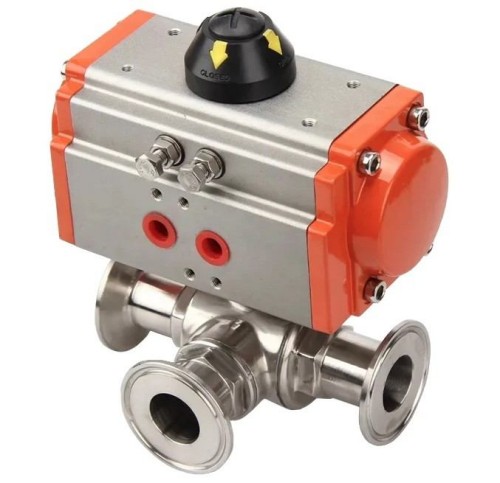
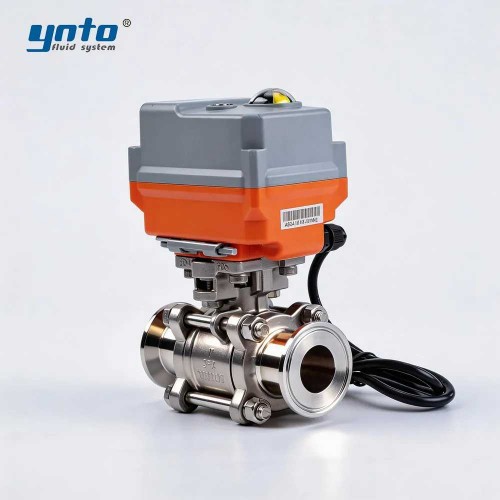
· Actuated Ball and Butterfly Valves: For larger flow control, we often use ball or butterfly valves with electric or pneumatic actuators. Each actuator type brings different dynamics. An electric actuator offers precise positioning and is ideal for a modulating electric control valve that might continuously throttle flow (for example, maintaining flow in a heat exchanger). Electric units move slower (typically taking a few seconds to stroke), which can prevent sudden shocks to the system. I’ve installed a 2″ electric ball valve (BSP threaded) in a hot water line; its leisurely 5-second close time saved the piping from pressure spikes that a fast pneumatic slam would have caused. On the other hand, pneumatic actuators are workhorses for speed and simplicity – as long as you have plant air. A pneumatic valve can cycle in a split second, useful for emergency shutdowns or high-cycle applications. Pneumatics also excel at fail-safe: spring-return designs can fail-open or fail-closed on loss of air, a key safety feature for many processes. One challenge I often check is air quality – wet or dirty air can corrode actuator internals or slow down response. We add filter-regulator-lubricator (FRL) units and even limit switches or positioners to pneumatic setups for feedback and finer control.

· Hydraulic Actuators and Valves: In scenarios requiring muscle – like a remote pipeline choke or a massive refinery valve – a hydraulic valve actuator can be the solution. Hydraulics deliver high torque from a small package (fluid power is dense), easily driving large gate valves or critical control valves against high differential pressures. I’ve specified hydraulic actuators for a high-pressure steam turbine trip valve where air supply wasn’t reliable; the self-contained hydraulic unit offered consistent force. The downside? Hydraulics are slower and introduce complexity with pumps and oil reservoirs, and leaks of hydraulic oil can be an environmental and safety headache. They’re used sparingly – usually only where pneumatic or electric can’t do the job. But as an engineer, I keep them in the toolkit for those niche but critical applications (e.g. subsea valves or very high-pressure gas systems). When we commission these, we pay extra attention to hose ratings and oil cleanliness, since a clogged servo valve in a hydraulic actuator can be just as troublesome as a dirty pneumatic line.
· Diaphragm and Control Valves: For fine control of flow, pressure, or temperature, globe-style control valves with positioners come into play. These can be pneumatic control valves with diaphragm actuators or newer smart electric control valves. They aren’t about quick on-off, but about accuracy and stability. For example, in a reactor cooling loop, a pneumatic diaphragm control valve might throttle continuously to hold a jacket outlet temperature. The pneumatic diaphragm is inherently modulating; its flexibility provides a smooth response to small control signal changes. In recent years I’ve also seen electric control valves with smart actuators (including fieldbus or 4-20mA control) where compressed air isn’t available – these give similar throttling precision with the benefit of simple wiring. The key with any control valve is to size the valve for the flow conditions. An oversized control valve will operate mostly near closed position, which can cause instability (the valve jumps from closed to too open with tiny signal changes). We use standards like ISA 75 (IEC 60534) for control valve sizing to get an appropriate trim size so that the valve maintains control authority in mid-stroke where it’s most linear. In one troubleshooting instance, a control valve was hunting because it was oversized – the solution was to swap in a smaller trim (reducing the Cv), immediately taming the oscillations.

Materials of Construction: Why They Matter
Selecting valve materials is as critical as selecting the type. The wrong material can lead to premature failure, safety hazards, or even contamination of the product. In the food CIP system, for example, all wetted parts are 316L stainless steel to resist the hot caustic and acid cleaners. 316L (low carbon stainless) offers excellent corrosion resistance to chlorides and acids and prevents any metallic contamination (it’s standard per sanitary design codes). I recall inspecting an older system where some 304 SS valves were showing tea-staining and pitting because they were exposed to chlorinated water; we upgraded those to 316L and added passivation treatment, which solved the corrosion spots.

For seal materials, we juggle options like EPDM, FKM (Viton), and PTFE. Each has its sweet spot. EPDM is a versatile EP rubber that holds up well to steam and alkaline cleaners – it can handle temperatures up to around 150 °C and remains elastic even at sub-zero temps. It’s our go-to for many water and CIP applications, but we avoid EPDM in any oil or hydrocarbon service (oil causes EPDM to swell and degrade). That’s where FKM (fluoroelastomer) shines – Viton seals resist oils, fuels, and many solvents, and can take heat up to ~204 °C. We use FKM O-rings in high-temperature oil lines and where chemical resistance needs to be top-notch. One thing I caution younger engineers: no seal is universal. For instance, FKM is great with fuel, but will fail if there’s steam or hot water cycling – in those cases EPDM or silicone might be better. PTFE seats and gaskets are another category; PTFE (Teflon) is chemically inert to almost everything and has a wide temperature range (up to ~260 °C). In our valves, PTFE seat inserts give tight shutoff and clean service (important for food-grade), but pure PTFE can creep (“cold flow”) under high pressure. To counteract that, we often use reinforced PTFE or PEEK inserts for higher pressure high pressure valve designs. A recent project with a caustic soda line at 10 bar and 120 °C used a PTFE seat initially – we observed a slight weep past the ball after thermal cycling. The cause was thermal expansion and seat deformation; the effect was loss of tight seal; the impact was a drip of caustic observed at the drain. We retrofitted PPL (a filled PTFE blend) seats which maintained a seal up to 200 °C and that stopped the leak. In extremely abrasive or hot services, we opt for metal seats (hardened stainless or Stellite-coated) – these can handle 425 °C or more and abrasive slurries, albeit with a sacrifice in achieving zero leakage. In fact, one slurry control valve we maintain has a tungsten-carbide coated plug and seat; it passes a tiny leakage (class IV shutoff) but survives where soft seats would be torn to shreds by particles.
To protect valve bodies externally and internally, coatings come into play. In a wastewater plant, I specified fusion bonded epoxy (FBE) coating on the interior of cast iron butterfly valves to fend off hydrogen sulfide corrosion. Similarly, for chemical service, Halar® (ECTFE) coatings are used on ball valves to create a shield on all wetted surfaces when even stainless might not be enough (e.g. strong acids, chlorinated brine). These coatings bond to the metal and dramatically improve longevity, but they require careful handling – a scratch during installation can become a corrosion hotspot later. I always stress to the team: never use a screwdriver to pry open a coated valve! We once had to re-coat a brand new valve because a technician scored the interior with a tool while installing – an avoidable delay and cost.
Safety is paramount when considering materials. Using materials incompatible with the process media can create hazards. For example, standard NBR rubber seals in an oxygen line can spontaneously ignite; hence we use EPDM or fluoroelastomers cleaned for oxygen service per ISO standards. And when handling chlorine, even 316 SS can suffer chloride stress cracking; Monel or Hastelloy might be needed – plus standards like ASTM G-93 for cleanliness to avoid any grease that chlorine could react with.
Standards and Safety Considerations in Valve Selection
Industrial valves must adhere to a host of standards to ensure safety, interchangeability, and performance. As a process engineer, I often live by the charts in ASME, API, and ISO standards:
· Pressure Ratings: Our BSP threaded electric valves typically conform to pressure ratings like PN10, PN16 (per EN/DIN standards) or Class 150, 300 (per ANSI/ASME). For instance, a valve rated PN25 means it holds 25 bar at a reference temperature (usually 20 °C). I’ve dealt with confusion in projects mixing PN and Class – e.g. a PN16 flange (~16 bar) is roughly equivalent to an ANSI Class 150 flange (rated ~150 psi). We have to ensure the spec sheets align; mismatching a Class 300 valve into a PN16 system could mean the valve is underutilized or the mating flanges don’t match drilling. The ASME B16.5 standard covers flange dimensions and pressure-temperature charts for classes – we consult these to verify that, say, a Class 150 valve made of CF8M stainless can really take about 19 bar at ambient, but only, for example, ~5 bar at 260 °C (pressure rating drops as temperature rises for most materials). We also refer to ASME B16.34 for valve design pressure ratings – every valve is designed to these standardized limits.

· Thread Standards: Since we focus on BSP threaded valves, the thread standard itself is critical. BSP (British Standard Pipe) comes in two forms – parallel (BSPP) and tapered (BSPT) as defined by ISO 228 and ISO 7 respectively. All our threaded electric valves are BSPP on the female ends with an O-ring groove, which seal nicely with a bonded washer, while male fittings are BSPT for a tight fit. I always double-check that a customer’s piping isn’t NPT by mistake. Mixing NPT and BSP threads is a notorious pitfall – a 1″ NPT will screw into a 1″ BSPT half-way and then bind. It gives a false sense that it fits, but it will not seal due to the 60° vs 55° thread angle difference. In fact, I’ve seen an incident where a mechanic mixed them – the joint leaked under pressure despite heavy thread tape. The cause was the thread mismatch; the effect was a spiral leak path; the impact was a spraying solvent that luckily was non-flammable. We had to replace that section with proper BSP fittings. Standards prevent these issues: we follow ISO thread gauges and markings (e.g. “G1” for BSPP, “R1” for BSPT) to avoid any confusion with NPT. For critical services, I specify threads to be gauged and inspected, and often we use thread sealant compliant with ANSI/ASME B1.20.1 (for NPT) or ISO 7 as needed.
· Fire Safety and Certifications: In hydrocarbon or solvent service, I lean on API standards for safety. API 607 fire-testing, for example, ensures that a valve can withstand a burn and still not leak excessively – important for an electric valve actuating fuel lines. We had a project for a fuel depot where all electric shutoff ball valves needed API 607 certification; their seats were graphite-lined and the design included live-loaded gland packing that would swell and keep sealing even if the polymers burned off. Another relevant one is API 6FA, another fire test spec for valves. Additionally, valves in certain services must meet fugitive emissions standards (like ISO 15848 or EPA requirements) to minimize leakage of volatile organic compounds. I specify bellows-sealed globe valves or special low-emission stem packing when dealing with toxics or high VOC solvents. Safety also extends to actuation: electric actuators often need ATEX (EU Explosive Atmosphere) or UL Class I Div 2 ratings if in a flammable gas area. That’s why the pictured solenoid valve above is an explosion-proof model – it meets Ex d IIC T6 rating for zone 1 hazardous areas, meaning it can safely contain any spark within. Our larger electric actuators for valves often have to comply with IEC 61508 / SIL ratings when used in safety-instrumented systems – basically, they have a quantified reliability. For example, an emergency shutdown actuator valve assembly might be SIL2 capable, giving the plant confidence it will perform on demand with a very low failure probability.
· Dimensions and Interchangeability: Standardization also makes life easier when replacing or upgrading valves. We rely on standards like DIN 3202 and ANSI/ISA-75 for face-to-face dimensions of valves, ensuring that a valve from one manufacturer can be swapped with another without re-piping. Likewise, ISO 5211 for actuator mounting pad dimensions has been a godsend – it allows us to mix-and-match actuators and valve bodies. I recently took advantage of this when a pneumatic actuator failed; we didn’t have the exact OEM part, but a different brand actuator with the same ISO 5211 flange pattern was on hand – it bolted right onto the valve body and we were back in operation within hours. Standards truly streamline maintenance and upgrades.
Conclusion: Toward Reliability and Continuous Improvement
After tightening the last gland nut and verifying the positioner tuning, I step back and watch the CIP line in operation. The BSP threaded electric valve now responds smoothly to control signals, and the earlier chatter is gone. No more weeping from the joints – fresh PTFE tape and careful torquing of the threaded BSP fittings have ensured a tight seal. In reflecting on this and countless other valve challenges, the takeaway is that successful valve management is equal parts engineering expertise and practical experience. You learn to anticipate issues: a slight lag in an electric control valve might foreshadow a sticky stem, a muffled pop in a pneumatic valve could hint at a dampener issue, or a gradual drifting closed of an actuator valve might signal spring fatigue or hydraulic oil leak.

Moving forward, the industry is embracing smart valves and IIoT sensors – valves that self-diagnose friction changes or send alerts if performance deviates. These are exciting developments that will enhance predictive maintenance. For example, next-generation electric actuators with integrated torque sensors can detect a sticking valve stem before it stalls, flagging the need for service. In one pilot project, we installed such units on steam control valves and saw a reduction in unplanned downtime, because the actuator’s diagnostics gave us a heads-up about developing issues (like a bit of scale accumulating on the plug).
However, even as automation and analytics improve, the insight of an experienced engineer remains invaluable. Standards and specifications guide us, but it’s the on-site observations – the subtle sounds, pressures, and even smells – that often lead to the root cause of a valve issue. In practice, I encourage younger engineers and technicians to spend time in the field: feel the pipe vibrations, listen to the actuator hum, observe how a high pressure valve in a compressor discharge behaves differently than a low-pressure CIP rinse valve. Each application has its nuances.
In conclusion, BSP threaded electric valves and their kin are foundational in industrial applications ranging from chemical plants to water treatment to food processing. Their success lies in choosing the right type and materials for the job, adhering to standards (for both safety and compatibility), and continuously monitoring their performance. As processes evolve – with higher automation, new materials like composite valves, and more stringent environmental standards – the role of the valve engineer is to marry these innovations with hard-won field wisdom. By doing so, we ensure that each valve, be it a simple on-off solenoid or a critical modulating control valve, operates safely and efficiently throughout its life cycle. If there’s one thing my 15+ years have taught me, it’s that every valve has a story, and it’s our job to listen and guide that story to a happy ending.

For complex systems or when in doubt, never hesitate to consult experts – whether it’s the valve manufacturer, a materials specialist, or a senior engineer who’s “seen it all.” Through collaboration and continuous learning, we can tackle current challenges and also anticipate future ones – such as integrating valves into digital twins for simulation, or adopting new standards for hydrogen service valves to support the energy transition. The world of industrial valves is constantly advancing, and by staying technically curious and grounded in real-world practice, we ensure these unsung workhorses keep our industries running smoothly for decades to come.

- 2026-10-12 15:56:29
- 2026-10-09 14:26:55
.png?imageMogr2/format/webp)
- 2026-09-30 08:25:23