

What Are Electrically Operated Valves?
- 2025-12-08 12:00:00
- admin
- NO COMMENTS
Imagine a late-night commissioning at a dairy plant’s CIP (Clean-in-Place) station. Stainless pipelines spider through the cleaning skid, carrying hot caustic solution at 80 °C and rinse water to sterilize equipment. An engineer watches as an automated valve is supposed to shut after a caustic cycle – but a problem emerges. The valve’s position indicator reads “Closed”, yet a thin stream of alkaline cleaning fluid still trickles past into the rinse line. Nearby, another motorized valve hesitates to open on command, causing a 3-second lag that sends a pressure spike through the system as a pump forces fluid against a not-yet-open pathway. In many field cases like this, engineers encounter valves that don’t fully close, actuation delays, or minor leakage that isn’t just an annoyance – it’s a contamination and safety risk. These real-world hiccups underscore why valve operation is critical and how upgrading to the right technology can make all the difference.

Field Challenges with Valve Actuation
For commissioning engineers, such scenarios are all too familiar. A valve that doesn’t fully seal can allow unintended mixing of fluids or gradual pressure loss. In our CIP station example, the root cause was traced to insufficient actuator torque → which caused incomplete valve closure → leading to caustic carryover into the freshwater line. This causal chain began with an under-powered electric actuator (or a sticky valve seat) and ended with process fluid contamination. The operational impact? The next production batch risked spoilage because cleaning solution crept into the product stream.
Meanwhile, the valve that lagged in opening created a different cause-effect chain: calibration error in the control signal → actuation delay → pressure spike at the pump outlet. Essentially, the control system sent the open command, but the valve’s actuator response was sluggish. The effect was a momentary pressure buildup (to ~6 bar from a normal 4 bar) as the pump ramped up against a closed valve. The operational impact here was a water hammer jolt that rattled the pipes and could fatigue joints or trip a pressure alarm. One engineer on-site even noted, “The torque spike was audible – the actuator motor groaned before the valve suddenly swung open.” Such torque spikes not only stress the valve stem and seals but also indicate the actuator might be fighting against a stuck valve or high differential pressure.
During inspection, technicians observed telltale signs: slight leakage past the valve seat, a warmed actuator motor (from working overtime to seat the valve), and alignment marks showing the valve disc stopped a few degrees shy of fully closed. All signs pointed to the need for a better solution in this service.
How Electric Actuators Solve Valve Problems
Electrically operated valves – often simply called electric valves – are valves equipped with an electric actuator that drives the opening and closing action. Unlike manual valves or even some pneumatic systems, electric actuators deliver consistent torque and can be finely controlled for position. In our scenario, upgrading to a properly sized electric actuator with higher torque eliminated the incomplete closure issue. The new actuator had a smart control unit that ensured the valve fully seated with adequate force, while also providing feedback to the control system on its exact position. As a result, if a valve still isn’t fully closed due to an obstruction or wear, the system knows from the feedback signal – no more false “Closed” indication while fluid slips by.

Meanwhile, the actuation delay was solved by using an electric actuator with a modulating control feature. The valve’s positioner was tuned so that the moment a 4–20 mA command signal arrives, the actuator responds immediately and proportionally. In practice, this meant the valve began opening without hesitation, synchronizing with the pump startup and preventing pressure spikes. For critical lines, engineers can even program a soft start – the electric actuator opens the valve slightly slower or in a controlled ramp, so pressure changes are gradual. This level of control is difficult to achieve with purely manual operation and shows how electric actuators enhance system stability.
From a valve engineer’s viewpoint, electrically operated valves turn previously unpredictable manual operations into precisely repeatable actions. You can fine-tune how a valve closes against the seat, avoiding both excessive force (which can wear out seals) and insufficient force (which causes leaks). In the CIP plant, for example, the replacement electric actuator was tuned to apply just enough torque at the end of travel to achieve Class VI shutoff (bubble-tight sealing) with its PTFE seat – achieving zero leakage where the old unit faltered. The new setup also logged the valve’s travel time on each cycle, so if over time the actuation takes longer (perhaps due to friction or deposit buildup), maintenance can be alerted to check the valve before it fails.

Types of Electric Valves: Ball, Butterfly, and Control
Electrically operated valves come in various types, each suited for different applications. The common styles a process engineer encounters are ball valves, butterfly valves, and control valves – all of which can be automated with electric actuators for improved performance.
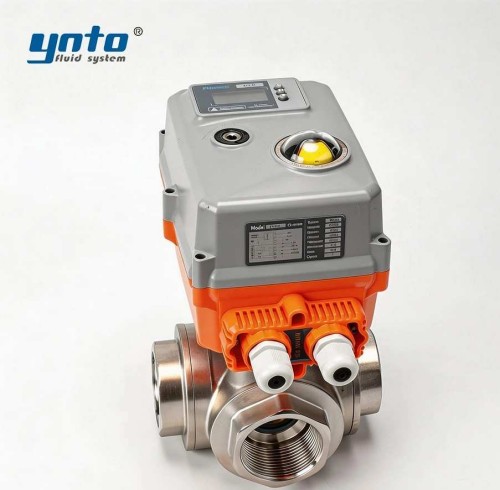
· Electric Ball Valve: This is a quarter-turn valve with a rotating ball that has a bore. When fitted with an electric actuator, an electric ball valve offers fast on-off control and tight shutoff. Ball valves are robust and ideal for isolation duties – for example, cutting off flow of a CIP chemical line or toggling a cooling water feed. They can handle high pressures and, with the right seat materials, achieve zero leakage. In slurry or viscous media, a V-port ball design is often used to throttle flow more predictably. (Many engineers favor ball valves for critical isolation because when the actuator turns that ball 90°, you either have full flow or a solid shut seal – little in between). However, a poorly sized actuator on a ball valve can fail to unseat it if pressure has built up behind the ball. That’s why selecting an actuator with sufficient breakaway torque is essential. Modern electric ball valves often include ISO 5211 mounting interfaces for easy actuator attachment and can be built from materials like stainless steel 316L or even PVC/PP for corrosive fluids.
· Electric Butterfly Valve: Butterfly valves use a flat disc that rotates a quarter-turn to open or close, and they excel in larger pipe diameters due to their lightweight and compact design. An electric butterfly valve is commonly found in water treatment plants, food & beverage lines, and HVAC systems where fast operation and lower cost are priorities. For instance, in our scenario the CIP return line could use a PVC-lined butterfly valve with an electric actuator to stop flow of cleaning solution. These valves typically have a seal ring (liner) of EPDM, NBR, or PTFE and can provide reliable shutoff for low to medium pressures. One consideration is that butterfly valves generally have a smaller torque requirement compared to ball valves of the same size, but the torque profile is nonlinear – it spikes at certain angles as the disc pushes through fluid. Electric actuators handle this by providing high torque at the start and end of travel. Engineers also appreciate that electric butterfly valves can be configured for modulating service: the actuator can park the disc at intermediate positions to control flow. However, achieving fine control near the mostly-closed position can be tricky due to the flow characteristic of butterfly valves (which is more linear near fully open and quite sensitive as it closes). Still, with a quality electric actuator and perhaps a geared linkage, a butterfly valve can double as a simple control valve in many systems.

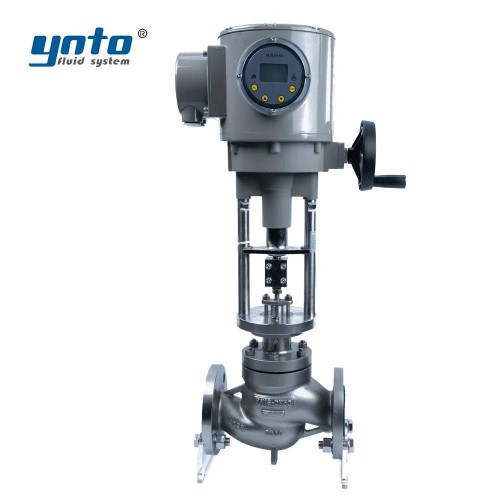
· Electric Control Valve: The term control valve often refers to a valve (like a globe, segment ball, or specialized control valve body) that is designed for precise throttling of flow, pressure, or temperature in a process. When paired with an electric actuator, an electric control valve can accurately regulate flow in response to a control signal. For example, a chemical dosing system might use an electric control valve to continuously adjust the flow of a chlorine solution, maintaining a target ppm level in a water stream. Electric control valves are usually equipped with positioners – devices that ensure the valve attains the position dictated by the 4–20 mA or digital control signal. In practice, an electric control valve can be a globe valve with a multi-turn electric actuator for fine linear positioning, or a V-port ball valve or butterfly with a modulating actuator for an approximate control. The key is the combination of valve design (trim characteristics) and actuator precision. Control valves often must strike a balance between fast response and stability; an electric actuator’s stepper motor or servo control can achieve small incremental movements to fine-tune the valve opening. For critical applications, features like feedback potentiometers or encoders in the actuator provide confirmation of position, and some units even have fail-safe options (e.g. a spring-return or battery backup that drives the valve to a safe position on power loss). This ensures that even though electric actuators typically stay put on a power failure (unlike spring-return pneumatic actuators), the valve can still fail open or fail closed as required for safety.
Each of these electric valve types addresses the problems we saw in the opening scenario. A properly selected electric ball valve would have closed fully under adequate torque, preventing leaks. An electric butterfly valve with the right actuator gearing would have opened on cue, avoiding pressure spikes. And for fine control of flow rate, an electric control valve would modulate precisely to maintain process conditions (like keeping a CIP solution at the right concentration or a pipeline at the right pressure).
Safety and Standards in Design
When dealing with industrial valves, safety requirements are paramount. A valve must contain pressure without rupture, handle the medium’s risks (be it corrosive chemicals, high-purity fluids, or flammable oils), and fail in a safe manner. Engineers specify electrically operated valves with multiple safeguards: torque limiters, overload protection, and sometimes manual overrides in case of control failure. For example, many electric actuators have built-in torque sensors and limit switches that cut power if the valve hits an obstruction or end-of-travel. This prevents the motor from straining indefinitely (avoiding a burnout or a sheared stem). Operational safeguards can also include local emergency stop buttons on the actuator, and indicator lights to clearly show if power is on or if a fault has occurred.

Valve assemblies must also comply with industry standards, which govern everything from dimensions to testing. In the U.S., valves often adhere to ANSI/ASME specifications for flange dimensions and pressure ratings, ensuring that an electric valve will mate with standard pipelines and can handle the designated pressure class. For instance, an electric ball valve might be rated ANSI Class 150, meaning it’s designed per ASME B16.34 to handle around 285 psi at ambient temperature. In Europe, the equivalent might be a PN10/16 rated valve per DIN standards. The goal is the same: pressure containment that meets a defined safety margin. Reputable valve manufacturers also follow API standards, especially for valves in oil & gas service. API standards (like API 607 for fire-safe design or API 598 for leak testing) add extra assurance. API 598 in particular defines how valves should be shell-tested and seat-tested for leakage – many electric valves aimed at critical service are tested to zero visible leakage per API 598 for soft seats, or to a low permissible rate for metal seats. Control valves often follow ISA/FCI standards; for example, ANSI/FCI 70-2 defines six leakage classes for control valves ranging from Class I (least tight) to Class VI (bubble-tight soft seat). An electric control valve specified for, say, Class IV leakage (common for metal-seated control trim) will be tested to ensure it leaks below a tiny fraction of flow at closed position.
Compliance with ISO standards is also important, especially in global projects. ISO 5211, for example, standardizes the interface between valves and actuators – a seemingly small detail that ensures your electric actuator can mount on a valve of a different make, as long as both follow ISO 5211 flange dimensions. Quality management via ISO 9001 certification is common among valve manufacturers to ensure consistent manufacturing and testing processes. Additionally, you’ll see CE and DIN EN markings on electric valves used in Europe, indicating conformity to EU directives (like pressure equipment directive). Ultimately, these standards and codes shape the design: they dictate how thick the valve walls must be, how strong the bolts, how the sealing surfaces should be finished, and how valves are factory-tested before shipment. By adhering to ANSI, API, ISO, and DIN requirements, an electrically operated valve is vetted to perform safely under the promised conditions – be that 10 bar in a food plant or 1500 psi on an oil pipeline.

Material Selection and Corrosion Resistance
Selecting the right materials for an electric valve is crucial for both performance and longevity. In our CIP example, the media ranged from water to caustic and acidic solutions, all at elevated temperatures. For such duty, 316L stainless steel is a popular choice for valve bodies and discs – its low carbon content (L-grade) resists corrosion even if welding is involved and minimizes contamination (it’s food-grade compliant). For more aggressive media or chloride-rich environments (like brine or bleach solutions), duplex stainless steels (such as ASTM 1.4462 / 2205 duplex) offer higher strength and pitting resistance. In fact, many butterfly valve discs and ball valve trims are available in duplex steel for this reason. If that’s not enough, high-alloy materials like Hastelloy (alloy C-22) might be used for discs or balls, especially when handling strong acids.
But metal selection is just half the story – seals and lining materials matter greatly. Electric valves often incorporate soft seats or liners made of PTFE, EPDM, FKM (Viton), and others to ensure tight shutoff. Each of these has distinct advantages: PTFE handles high temperatures and almost any chemical (great for aggressive acids or solvents) and gives a low friction coefficient; EPDM is an excellent general-purpose elastomer for water, steam, and dilute chemicals (commonly used in food/pharma CIP because it’s steam sterilizable); FKM (Viton) is superb for oils, fuels, and many solvents, known for its high temperature capability and chemical resilience. In an electric butterfly valve for chemical service, you might see a PTFE-lined body or a PTFE seat with an EPDM or FKM O-ring energizer – combining properties for a reliable seal. For example, one high-performance butterfly valve design uses a PTFE lining with an EPDM backup ring to ensure zero-leakage sealing (achieving ANSI Class VI shutoff). The choice depends on the media: EPDM would be unsuitable for oils (it swells), whereas FKM would be overkill for hot water where EPDM shines.

Corrosion protection can go beyond alloy selection. In extremely corrosive services (think of 98% sulfuric acid or aqua regia), even exotic alloys may not hold up, so valves employ anti-corrosion coatings like Halar® (ECTFE) or PFA. A Halar-coated butterfly valve disc, for instance, has a chemically inert fluoropolymer layer over a metal core, marrying strength with corrosion resistance. Halar (a type of fluoropolymer) can make a steel valve usable in ultra-aggressive environments by isolating the metal from the process fluid. We see this in some chemical plants: an electric actuator is mounted on a carbon steel butterfly valve body, but all wetted surfaces are either PTFE-lined or Halar-coated, and the seat is PTFE – effectively nothing in contact with the fluid is reactive. This strategy also applies in high-purity applications (like semiconductor ultra-pure water or pharmaceuticals) – valves might be lined or made entirely of plastics (UPVC, PVDF) to avoid metal contamination. Indeed, PVC, CPVC, PVDF electric valves are common for lower-pressure, highly corrosive duties; their electric actuators are usually isolated from the fluid by plastic bodies and often rated NEMA 4X/IP67 for washdown and corrosive atmosphere protection.
Finally, consider temperature and mechanical stress when choosing materials. Electric actuators themselves often have housings of powder-coated aluminum alloy or stainless steel, but the valve body might need to be WCB carbon steel for high-pressure steam (with stainless trim for erosion resistance), or bronze for certain marine applications. In any case, material standards like ASTM and DIN material equivalents ensure that the specified 316L or duplex or alloy steel actually meets the required tensile strength and toughness at design conditions. The use of certified materials and proper coatings ties back to compliance as well – for example, FDA-approved materials for food service, or NACE MR0175 compliant materials for sour gas service to prevent sulfide stress cracking.
Conclusion
Electrically operated valves bring a new level of control and reliability to fluid systems by marrying robust valve hardware with precise electric actuation. Instead of an operator manually cranking a wheel and hoping a valve is fully closed, an electric actuator can guarantee it – applying consistent torque and confirming the position. The real-world problems of valves not closing, leaking, or responding sluggishly can often be traced to either the wrong valve type for the job or an inadequate actuation method. By switching to well-chosen electric ball valves, butterfly valves, or control valves – each equipped with the appropriate electric actuator – plants can automate away many of these issues.
For engineers, the beauty lies in the data and control: you can integrate these valves into a SCADA or DCS system, monitor exactly how many degrees open they are, how long they took to move, and even anticipate maintenance (e.g., if torque to close is creeping up, indicating wear or deposits). Safety is enhanced through built-in failsafes and compliance with rigorous standards (ANSI/API for design and testing, ISO/DIN for compatibility and quality). And with the right materials – stainless steels, high-grade alloys, and engineered polymers – electric valves can handle high pressure, extreme temperatures, and corrosive media while maintaining tight shutoff and smooth operation.
In summary, electrically operated valves are not just a definition from a textbook, but a practical solution born from field experience. They are the silent guardians in water treatment stations, food processing CIP loops, chemical dosing systems, and oil pipelines – constantly adjusting, opening, closing, and safeguarding the process. Next time you walk through a plant and hear the hum of an electric actuator turning a valve, you’re witnessing improved process control in action. For the commissioning team in that dairy plant, the upgrade to electric valves turned headache into relief – no more leaks, no more surprises, just a reliably closed valve when it’s supposed to be closed, and a smoothly running process. That’s the difference electrically operated valves make, and why they’ve become the go-to choice for modern automated flow systems.


- 2026-09-14 15:59:43

- 2026-09-11 16:48:37
- 2026-09-09 09:50:27