

Unlocking Efficiency: Smart Valves in Industry 4.0 Factories
- 2026-01-20 12:00:00
- admin
- NO COMMENTS
Situations like this are common in traditional plants. A corroded residue on that valve’s body hints at another problem: the cleaning chemicals (acidic sanitizers) have slowly pitted the wrong material choice over time, resulting in rough internal surfaces and even shorter seal life. These cascading issues – pressure fluctuations → valve vibration → component wear – force unscheduled maintenance and raise safety concerns. For a procurement manager balancing production targets and budget, each unplanned shutdown is costly. The scene above could have escalated to a major downtime event, but it also presents an opportunity. Modern factories are embracing smart valves and Industry 4.0 solutions to prevent these headaches altogether. By upgrading to intelligent, connected valves, the dairy plant can transform this reactive firefighting into proactive optimization.
The Evolution of Valve Technology
Valve technology has come a long way from the days of manual wheel cranks and guesswork. Seasoned engineers remember when a valve was purely mechanical – turn a handwheel and fluid flow changes, with no feedback beyond a pressure gauge down the line. Over time, basic automation arrived: pneumatic diaphragm valves and air-powered actuators became common, allowing remote control from a control room via air signals. A classic pneumatic actuator uses plant air to move a valve, improving safety (no manual intervention in hazardous areas) but still offering limited insight into what’s happening inside. As electronics advanced, electric actuators and positioners emerged, marrying motors and sensors to valves. An electric actuator mounted on a valve could receive precise setpoints from a PLC and adjust instantly – a big step toward today’s industrial automation.
Meanwhile, control engineers introduced early digital positioners on pneumatic control valves to get feedback on valve position. By the 2000s, plants were dotted with these semi-smart valves: a pneumatic control valve equipped with a position transmitter or a limit switch could tell operators if it was actually open or closed. Fast forward to today’s Industry 4.0 era – valves are evolving into fully cyber-physical systems. The humble “final control element” is no longer a dumb piece of metal; it’s becoming a node in the digital network, complete with processors and communication capabilities. This evolution didn’t happen overnight. It’s the result of incremental improvements: better materials, integrated electronics, and industry’s demand for data. Modern electric control valves often come with onboard diagnostics, and a new generation of smart valves is capable of self-tuning and health monitoring. For engineers, it’s like going from driving blind to having a full instrument dashboard for each valve. But what exactly does Industry 4.0 mean for valves?

Defining Industry 4.0 in the Context of Smart Valves
Industry 4.0 – often called the Fourth Industrial Revolution – signifies connected, intelligent manufacturing. In valve terms, it means embedding computing and connectivity into valves so that they sense, adapt, and communicate. Key technologies driving this revolution include the Internet of Things (IoT), advanced sensors, cloud computing, and machine learning. In an Industry 4.0 factory, a smart valve is equipped with sensors for pressure, temperature, position, even vibration. These sensors continuously feed data to a central system. The valve becomes part of a larger cyber-physical system – a seamless blend of physical equipment with digital control and monitoring. For example, a smart diaphragm valve on a CIP line might report its opening percentage, the flow rate, and the exact temperature of the cleaning solution passing through, all in real time.
Key technologies are making this possible. Miniaturized pressure transducers and acoustic sensors can be built into valve bodies to detect subtle changes (like a whisper of fluid passing a not-quite-sealed seat). Wireless IoT modules can transmit data from valves situated in hard-to-wired locations, eliminating the cost of running cables across a plant. Communication protocols like HART, Modbus, and industrial Ethernet allow valves and actuators to “talk” to the control system and each other. Crucially, all this data and connectivity turn valves into active participants in automation. They’re not just obeying commands; they’re also providing insights. A smart valve in an Industry 4.0 solution can integrate with the factory’s MES (Manufacturing Execution System) or cloud platform, contributing to big-picture analytics.

Understanding cyber-physical systems is key to grasping the impact. In a cyber-physical valve system, the physical actions (throttling flow, opening, closing) are tightly integrated with digital control algorithms and feedback loops. The valve’s behavior can be simulated and optimized in a digital twin – a virtual model – before it ever tweaks a real process. For instance, the dairy plant could simulate how a new electric butterfly valve will respond during CIP transitions (hot to cold flow) in software, identifying potential stress points on seals in advance. Such integration means fewer surprises during operation. The result is a manufacturing environment where valves adjust on the fly to process conditions, guided by both sensor input and predictive algorithms. The impact? Greater responsiveness and resilience. If one pump in the CIP system starts to falter, smart valves downstream can autonomously slow the flow to prevent pressure spikes, all while notifying operators of the anomaly.
Real-Time Monitoring: The Backbone of Modern Manufacturing
In modern factories, real-time monitoring is indispensable – and smart valves are at its core. Gone are the days when an operator would walk around with a clipboard, listening for strange sounds or feeling pipe vibrations to judge a valve’s health. Today’s smart valves continuously stream data on their status and the process fluid’s conditions.
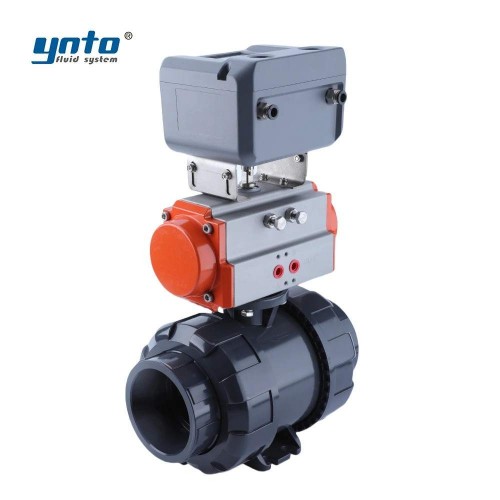
Smart valves with digital actuators in a modern plant enable continuous monitoring. For example, an electric ball valve on a pasteurization line might constantly report its position (open, closed, or % open) and detect how fast it moved during the last operation. If it suddenly takes longer to cycle, the system knows something might be causing drag – perhaps residue build-up or a failing actuator motor. By having this granular, moment-to-moment feedback, the plant’s control system can maintain optimal performance and safety without manual intervention.
The Role of IoT in Enhancing Monitoring
The IoT in manufacturing refers to all those connected sensors and devices (the “things”) feeding into a network. Valves are perfect candidates. A network of IoT-enabled smart valves essentially acts as the factory’s nervous system. Each valve, equipped with sensors and a communication module, sends readings to a gateway or cloud platform. In our CIP scenario, the moment that valve started rattling, an IoT-enabled vibration sensor could have sent an alert: “Hey, vibrations exceeded normal levels during the hot water surge.” Operators would see this on a dashboard instantly, pinpointing the exact location and time. Furthermore, IoT connectivity allows remote monitoring. A procurement manager or plant supervisor off-site could check the live status of critical valves from a laptop or phone – useful for multi-facility management or overnight shifts.
Another IoT advantage is automatic interlock and control. Since valves can communicate, they can be programmed to respond to each other. If a temperature sensor on a pipe detects an abnormal drop, the nearby smart valve could automatically throttle back to prevent thermal shock, then send an alert. All of this happens in split seconds, far faster than a human could react. By enhancing monitoring capabilities through IoT, factories gain not only speed but also a rich dataset for analysis. Over a month, a smart valve might generate thousands of data points about flow rates, cycles, and slight pressure changes. This continuous data flow builds a story of the process that engineers can analyze for improvements.

Benefits of Continuous Data Flow in Factories
Having continuous data from smart valves is like having a live health report on your process. The benefits manifest in several ways. First, early fault detection: Even minor anomalies are caught. For example, a slight drift in a valve’s closing position (perhaps it’s only reaching 95% closed when it should be 100%) will show up in the data. Continuous monitoring might reveal that over the last week, each closing cycle left the valve a fraction more open than the previous one – a clear trend indicating wear or an obstruction. Catching this trend means maintenance can be scheduled before a full-blown leak or quality issue occurs. Second, process optimization: when you know exactly how each valve is performing, you can fine-tune operations. Maybe the data shows a particular electric actuator is using more power to move a valve at certain times of day – investigating might reveal a pressure surge that can be mitigated by adjusting pump scheduling. Perhaps continuous flow data highlights an imbalance – one branch of a process is running slower because a valve isn’t opening fully. By addressing it (maybe recalibrating that valve’s actuator or cleaning a filter), the plant can remove a bottleneck.
Continuous data also feeds higher-level smart manufacturing solutions like AI-driven control. With rich datasets, machine learning models can be trained to recognize patterns that humans might miss. For instance, a combination of a slight temperature rise in a valve’s housing along with a subtle increase in required torque might precede a failure – an AI could flag that pattern early. Ultimately, this data-driven approach means less guessing, more knowing. It’s a backbone for reliability, letting the team focus on improvement rather than constantly reacting to surprises.
Embracing Predictive Maintenance Strategies
One of the most game-changing benefits of smart valves is predictive maintenance. Instead of waiting for something to break or relying on a fixed maintenance schedule (“grease this valve every 3 months whether it needs it or not”), predictive maintenance uses real-time data and analytics to service equipment only when needed – and right before a failure would occur. For valves, this is revolutionary. Think back to that aging valve in the CIP system: traditionally, it might be checked only during annual shutdown or when a leak is spotted. With predictive tools, the valve itself can alert the maintenance team of its condition.
Reducing Costs and Improving Reliability
From a procurement and operations perspective, predictive maintenance is all about reducing costs and improving reliability simultaneously. Unplanned downtime is the enemy of productivity – every minute a line is down can cost thousands in lost product, especially in continuous processes like food pasteurization or chemical production. Smart valves help avoid these costly incidents. For example, a limit switch or torque sensor on a smart valve can detect that the valve’s required closing torque has been creeping up over the last 100 cycles. That’s a telltale sign that something is causing extra friction – perhaps seal aging or debris. Instead of waiting until the valve gets stuck (and causes a production outage), the maintenance team gets a ticket in their system scheduling a service at the next convenient window. Downtime averted.
This data-driven foresight extends component life, too. Valves are expensive assets, especially large control valves made of exotic alloys for corrosive service. Replacing them too frequently is a budget drain. But with predictive insights, you might discover that a particular valve in a benign service could run twice as long before overhaul, because the data shows minimal wear indicators. In other cases, you’ll catch a degrading valve early and fix it cheaply (like replacing just a seal) rather than letting it run to failure and perhaps ruin the whole valve. The net effect is optimized maintenance spending: money is spent where it’s needed most, not based on generic schedules. Reliability naturally improves because the surprises fade away. A plant with dozens of smart valves feeding a predictive maintenance system can practically eliminate sudden valve failures that halt production. In terms of ROI, this is huge – one avoided shutdown often pays for the entire sensor and automation upgrade.
Technologies Enabling Predictive Maintenance
How exactly do smart valves predict their own maintenance needs? It’s a combination of sensors, analytics software, and sometimes even machine learning. On the sensor side, modern valves can be equipped with vibration monitors, temperature probes (to detect unusual heating which could mean friction), pressure sensors upstream and downstream (to detect if the valve isn’t holding pressure as it should, hinting at seat leakage), and travel sensors that record how fast and how far the valve moves for a given command. An electro-pneumatic positioner on a traditional pneumatic valve, for instance, can measure the response of the valve to a control signal. If it notices the valve is sluggish or overshooting, it signals a problem. These positioners essentially turn old valves into smart valves by providing a constant stream of performance data. Installing an electro-pneumatic positioner on an existing pneumatic actuator is a clever retrofit many plants use to get digital feedback without replacing the whole valve.

On the analytics side, the factory will use software – sometimes part of the control system, sometimes a dedicated platform – to crunch the incoming data. Machine learning algorithms can be trained on normal valve behavior versus failure cases. For example, by analyzing historical data, an algorithm might learn that a subtle oscillation in a valve’s stem movement, combined with a 5% longer closing time, precedes a spring failure in that valve’s actuator. Once trained, the system watches for that combination. When it appears, the system might generate an alert: “Valve X in Unit 3 likely needs spring replacement within 2 weeks.” These technologies essentially extend an engineer’s senses – instead of relying on human intuition alone, there’s a tireless digital assistant watching every valve 24/7. The result is a maintenance program that feels almost preventative in hindsight: issues are fixed proactively, costs are spread out and predictable, and the overall reliability of valves (and thus production) is up.
Process Optimization with Smart Valves
Smart valves don’t just prevent problems – they actively optimize process performance. Once a factory has real-time control and rich data from all its valves, it can fine-tune processes to a degree that was previously impossible. Consider the case of a brewery that upgraded its fermentation and CIP system with smart valves. Historically, they had to build in large safety margins for process variations – hold times a bit longer, flows a bit higher – because they didn’t have fine control. After installing new 316L stainless steel sanitary valves with precise electric actuators and sensors, they noticed they could cut their cleaning water usage by adjusting valve throttling more accurately during the rinse phase. In fact, one case study of improved efficiency showed that by using smart valves to modulate flow and monitor cleanliness in real time, a brewery reduced CIP water consumption by 20% and saved hours of downtime per week.

Another example comes from a chemical plant handling a corrosive process fluid. They replaced an old globe valve with a smart Hastelloy-lined control valve (featuring a corrosion-resistant trim and integrated sensors). This valve could dial in flows much more precisely. The real win was consistency: the tighter control reduced variability in the reaction temperature downstream, boosting product yield. Plus, because the valve’s sensors confirmed it was sealing fully each batch, they eliminated trace leaks that had been causing off-spec product. These efficiency gains are often a sum of small improvements: tighter control means less waste, faster adjustments mean shorter cycle times, and better sealing means higher quality output. Over time, such gains significantly impact the bottom line.
Integrating Smart Manufacturing Solutions into Existing Systems
A common concern for engineering teams (and procurement managers planning the budget) is how to integrate smart valves into existing systems. Many factories aren’t starting from scratch – they have plenty of conventional valves already installed. The good news is that Industry 4.0 doesn’t require a rip-and-replace approach. Smart manufacturing solutions can be phased in. One practical strategy is to start with critical problem areas. For instance, the dairy plant might identify the CIP circuit and a few key process valves as pilot candidates. They could install a few electric ball valves with built-in IoT connectivity and see immediate benefits in cleaning efficiency and downtime reduction. Those successes build the case (and confidence) to expand smart valves plant-wide.

Crucially, modern smart valves and actuators are designed with backward compatibility in mind. They often conform to the same ANSI/ASME flange standards and face-to-face dimensions as the valves they replace, making swap-out easy. Many smart actuator packages are built to ISO and DIN mounting standards, meaning a new electric actuator can often mount onto an old valve body with an adapter kit. This adherence to ANSI, ISO, and DIN standards ensures new components fit physically and interface correctly with legacy equipment. Even on the communication side, today’s smart devices usually support multiple protocols, so they can be shoehorned into older DCS (Distributed Control System) networks. It’s not always plug-and-play, but it’s far from starting over.
For pneumatic legacy valves, retrofitting is a popular approach: adding smart positioners or external sensors to give older valves a new lease on life. A limit switch package, for example, can be attached to a manual valve or older actuator to provide basic open/closed signals to the control system – not fancy, but it drastically improves visibility. The procurement manager overseeing upgrades will also care about standards & compliance. Rest assured, reputable smart valve manufacturers build devices to meet all relevant codes (for example, API standards for performance testing and leakage like API 598, and safety certifications). Before a smart valve goes into a high-pressure steam line, it will have undergone the same rigorous API/ASME pressure tests as any traditional valve. Compliance with standards like API, ANSI, and ISO means these new technologies maintain the safety and reliability benchmarks the plant already trusts. In short, integration is as much about good planning as it is about technology – and with careful planning, even an older factory can steadily transform into a smart manufacturing environment.
Conclusion: The Future of Smart Valves in Industry 4.0
As our dairy plant scenario illustrates, the drive toward smart valves in an Industry 4.0 world is not just hype – it’s a necessity for those seeking efficiency, safety, and competitiveness. Looking ahead, the future of smart valves will involve even more intelligence at the valve level. We can expect self-learning valves that adapt their control algorithms based on the media they handle, and even more integration with plant-wide systems. Some manufacturers are already exploring all-in-one valve assemblies with integrated sensors, actuator, and controller in a single package, simplifying installation and commissioning. This could be especially useful for modular skid systems or remote installations like well pads.
Challenges Ahead and Opportunities for Growth
That said, there are challenges ahead. One is cybersecurity – as valves become connected to networks, protecting them from hacking or malicious control is paramount. A compromised control valve could be as dangerous as a physical sabotage, so future designs are focusing on encrypted communication and fail-safe modes. Another challenge is the learning curve for personnel. Maintenance technicians and operators need training to confidently work with smart valves; interpreting diagnostics and managing firmware updates are new tasks in the valve world. There’s also the matter of initial cost. Advanced valves and actuators do come at a premium, and smaller manufacturers might hesitate. However, as with most technology, volume and competition are driving costs down. In fact, the market for smart valves is projected to grow at double-digit rates in the coming years, which will spur more affordable options and a richer ecosystem of service providers. This growth is an opportunity for growth in itself – companies that adopt early will reap efficiency gains and develop in-house expertise, putting them ahead of the curve.
From a materials standpoint, the future will likely see innovative materials and coatings that further extend valve life in extreme conditions (imagine self-healing coatings or new composites that handle even more abrasive or acidic fluids). Traditional materials like 316L, duplex stainless steels, and PTFE will remain staples due to their proven performance, but we’ll see more use of advanced alloys and polymers tailored for specific duties. For instance, super duplex stainless and ceramic-lined valves might become more common for certain Industry 4.0 processes like supercritical CO2 systems. Each new material development will dovetail with smarter monitoring – when you have a sensor-laden valve, you can push a new material to its limits and know in real time how it’s holding up.

In conclusion, the smart valve Industry 4.0 revolution is well underway, unlocking efficiency and insight in modern factories. For engineers on the plant floor, it means fewer nasty surprises – that midnight leak in the CIP line becomes a thing of the past because the valve would have “told” its story ahead of time. For a procurement manager, it means investing in technology that pays itself back through energy savings, reduced downtime, and extended equipment life. Safety is enhanced as well: automated valves with intelligent controls can shut down flows faster in emergencies and log every event for compliance, all while meeting stringent ANSI/API safety standards. The smartest valve, as some like to say, is the one that works flawlessly every time – and with Industry 4.0, we’re closer than ever to achieving just that across the entire plant. Embracing these innovations, and carefully integrating them with established practices, is key to staying competitive and optimizing processes in an increasingly demanding global market. The valves may be getting “smarter,” but their fundamental job remains the same: to keep our industries flowing smoothly, safely, and efficiently into the future.

- 2026-10-26 15:05:21
- 2026-10-23 10:30:14
- 2026-10-21 10:41:51