

PN16 Electric Butterfly Valves for Wastewater Retrofits
- 2026-10-16 10:48:59
- admin
- NO COMMENTS
At a wastewater pumping station, an aging butterfly valve may still open and close every time the operator sends a command, yet the system no longer behaves the way it did at commissioning. The actuator sounds slightly more strained near the closed position. Flow takes longer to stabilize after a pump changeover. During inspection, technicians find dampness around the seat area even though there is no obvious external damage.
Another plant may see the opposite problem. The valve closes quickly, but every shutdown produces a noticeable pressure pulse through the discharge header. The actuator is doing exactly what it was designed to do; hydraulically, however, the closing sequence is too aggressive for the pipeline.
These are typical reasons why a wastewater retrofit should not be treated as a simple “DN200 in, DN200 out” replacement. For PN16 electric butterfly valves, engineers need to examine sizing, seat material, operating torque, actuator behavior and closing time as one system. The objective is not merely to replace an old industrial valve. It is to remove the condition that caused unstable control, seal deterioration or repeated maintenance in the first place.
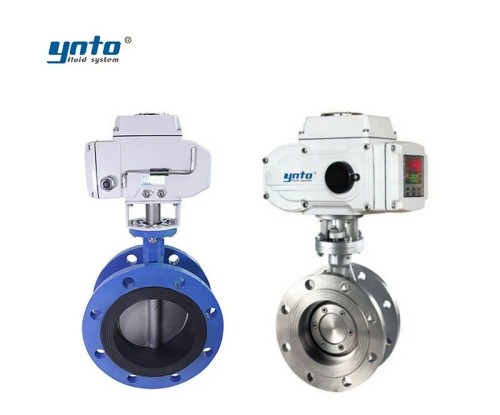
PN16 Electric Butterfly Valves for Wastewater Retrofits
The Role of Electric Butterfly Valves in Wastewater Treatment
Electric butterfly valves are frequently used in wastewater plants because their quarter-turn design is compact, relatively light for larger pipe sizes and straightforward to automate. They can serve on pump discharge lines, treated-water lines, aeration utilities, sludge-related services and general isolation duties, provided the valve materials and seat design match the actual medium.
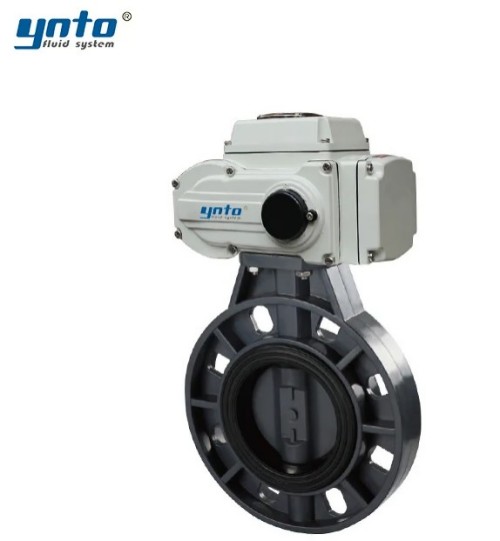
For retrofit projects, YNTO's range of electric butterfly valves includes flanged, wafer, lugged, plastic, stainless steel and different soft- or hard-sealing arrangements, giving engineers several mechanical configurations to evaluate against existing wastewater piping.
The first question on site is usually not “Which actuator do we want?” It is “What has changed in this line?”
An engineer walking the plant may notice rising differential pressure, deposits around the disc, increased operating torque, intermittent leakage after shutdown or irregular response at small valve openings. These observations often provide more useful information than the original valve nameplate.
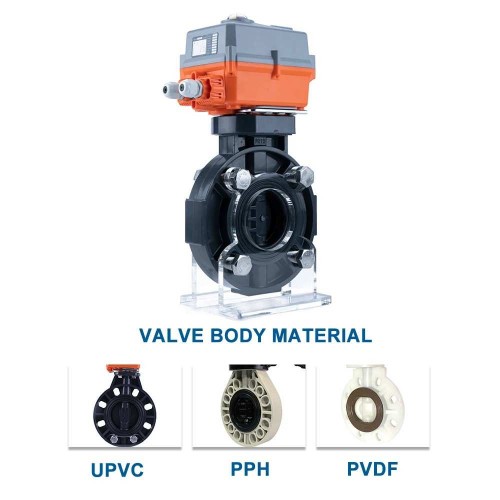
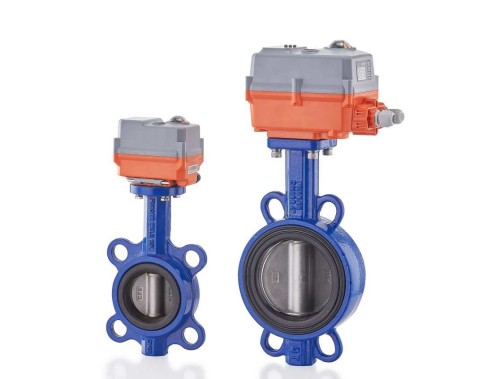
Definition and Application in Fluid Dynamics
From a fluid-dynamics perspective, a butterfly valve places a rotating disc directly inside the flow path. As the disc moves away from fully open, velocity distribution around it changes and pressure loss increases.
That relationship is nonlinear. A small change in disc angle does not always produce a proportional change in flow.
This matters in wastewater because the medium may contain suspended solids, entrained air, fibrous material or changing solids concentration. When a valve operates for long periods at a restrictive angle, localized velocity can increase around the disc edge. The resulting turbulence may accelerate seat wear, create vibration and increase pressure loss.
In field commissioning, an unstable flow signal is sometimes blamed on the actuator or PLC. Yet the actual cause may be hydraulic: the valve is oversized and operating close to the nearly closed region where a small angular movement creates a large change in flow.
Sizing therefore has to consider the required flow range and pressure drop, not only pipe diameter.
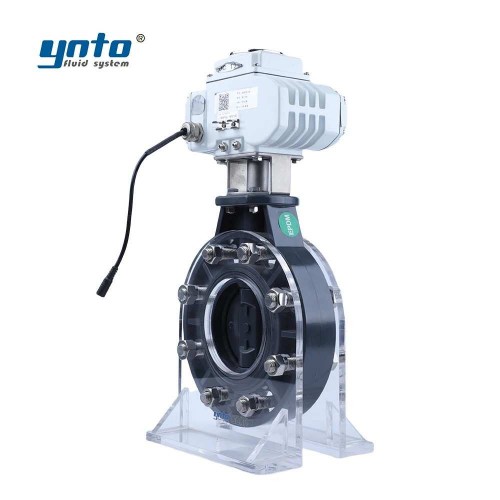
Advantages of Using Electric Actuators
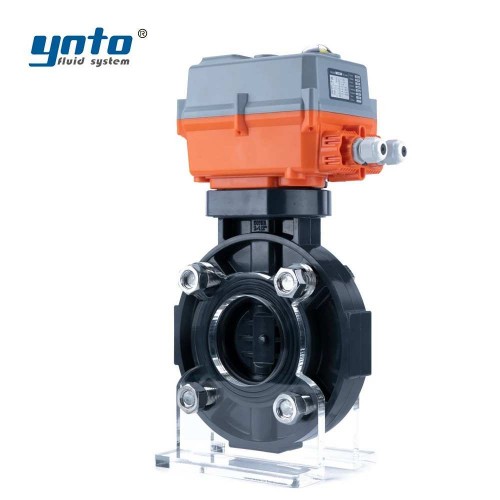
Electric actuation is attractive where compressed air is unavailable or where a wastewater plant wants centralized industrial automation. Position indication, remote commands, limit switches and modulating control can all be integrated into a plant control architecture.
For isolation duty, a simple open/close actuator may be sufficient. Where flow needs adjustment, a modulating actuator can position the disc between its end stops.
The practical advantage is repeatability. Operators no longer depend on manual valve position, and valves located outdoors, above tanks or in less accessible areas can be operated remotely.
There is also a safety benefit. Remote actuation can reduce the need for personnel to approach wet wells, chemical dosing areas or pressurized equipment simply to operate a manual valve.
Sizing Electric Butterfly Valves for Optimal Efficiency
Standard Sizing Guidelines for PN16 Valves
PN16 describes a nominal pressure class. It should not be interpreted as a guarantee that every valve can operate continuously at 16 bar under every temperature, material and service condition.
The actual allowable pressure depends on valve construction, temperature, seat material, body material and the applicable design standard. In retrofit work, engineers should therefore compare the valve's documented pressure-temperature capability with the plant's maximum operating pressure, pump shutoff pressure and possible transient pressure.
This distinction becomes important in hydraulic systems where a pump trip or rapidly closing valve can create a short pressure surge substantially above steady operating pressure.
Valve size should then be checked against design flow.
Simply matching a DN150 pipeline with a DN150 butterfly valve may work for isolation service, but it does not prove that the valve will provide stable throttling. The Cv or Kv characteristic, available pressure drop and intended operating angle need to be considered.
Considerations for Pipe Diameter and Flow Rates
Wastewater pipelines are often sized to maintain minimum transport velocity while avoiding excessive head loss. A butterfly valve introduced into that line becomes another hydraulic restriction.
If the replacement valve is too small, velocity through the valve rises. That increases pressure loss and can contribute to noise, vibration or erosion.
If it is unnecessarily large for the control duty, the disc may spend most of its time close to the shut position. Control then becomes sensitive because a few degrees of actuator movement can create a disproportionately large change in flow.
For engineers working on site, the useful question is: at normal operating flow, where will the disc actually sit?
A valve that spends most of its working life at a moderate opening is usually easier to control than one forced to operate near an extreme position.
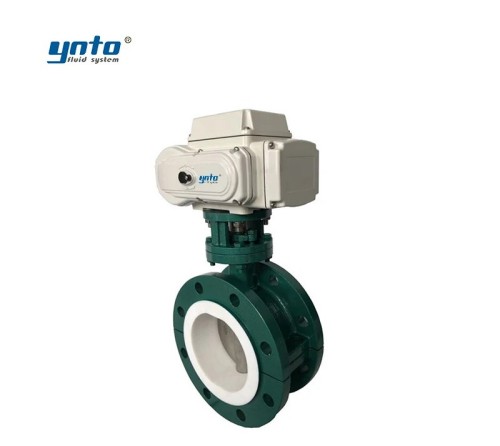
Impact of Valve Positioning on System Efficiency
Disc position influences not only flow but also pump operating conditions.
Suppose a pump discharge valve is partially closed to reduce flow. The restriction increases system resistance, the pump moves to a different point on its curve, and energy consumption may change. If the process permanently requires less flow, throttling may not always be the most energy-efficient method compared with pump speed control.
This is where sustainable engineering becomes more than a marketing phrase. Valve position, pump control and process demand should be evaluated together.
During a retrofit, trending differential pressure before and after the valve can reveal whether the old arrangement is wasting significant head.
Material Selection for Seats in Electric Butterfly Valves
Understanding Common Seat Materials: EPDM and PTFE
In wastewater service, the seat is often the component that determines whether an otherwise healthy valve stays reliable.
EPDM is widely used for water-oriented applications because it offers useful resistance to water, weathering and many dilute chemicals. YNTO, for example, offers a flanged electric butterfly valve with an EPDM seal, a configuration that can be evaluated for water and compatible industrial-fluid applications.
The limitation is compatibility. Wastewater is not always simply dirty water. Cleaning chemicals, oils, hydrocarbons, oxidizing agents and process discharge from upstream industries may all reach the plant.
PTFE provides broader chemical resistance for many aggressive services. Where chemical exposure is a concern, a ductile iron electric butterfly valve with PTFE sealing represents another material combination engineers can compare against the process chemistry.
Neither material is universally superior. Selection should follow actual media, concentration, temperature and mechanical duty.
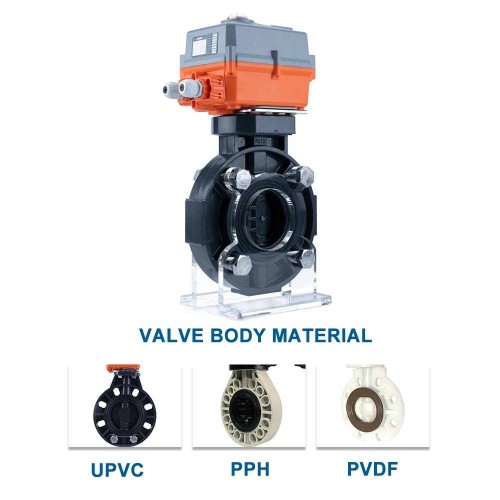
Chemical Resistance and Lifespan of Different Materials
A common failure chain begins quietly.
An incompatible chemical reaches an elastomer seat. The material gradually swells or loses elasticity. Contact between the disc and seat increases, breakaway torque rises, and the actuator begins working harder at every cycle. Eventually the valve closes slowly, stalls or develops leakage.
Replacing only the actuator does not solve that problem.
Another failure mechanism begins with abrasive solids. Repeated contact damages the sealing surface, the seal becomes less uniform, and leakage slowly increases. In this case, engineers may need to review disc material, seat geometry, solids loading and valve location rather than simply select a different motor.
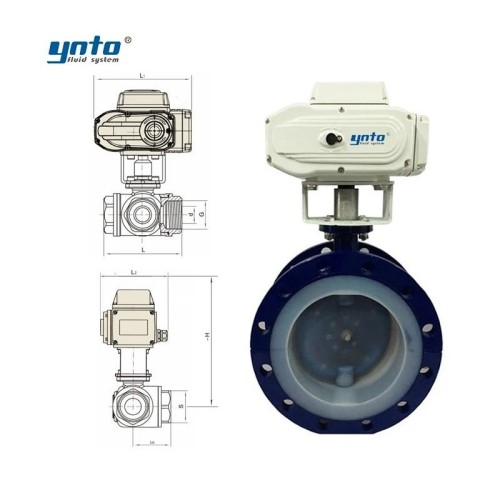
For the valve body and disc, ductile iron remains practical in many wastewater applications when appropriately protected. Stainless steels such as 316 or 316L can provide better corrosion resistance in selected services. More severe chloride environments may lead engineers toward Duplex or Super Duplex materials, while protective systems such as FBE coatings may be considered for certain bodies and external surfaces.
The seat may use EPDM, PTFE or another elastomer such as FKM according to the chemistry. Compatibility should always be verified against the real operating fluid.
Environmental Compliance Through Material Innovation
Material selection also affects environmental compliance.
A valve that begins leaking internally may allow untreated or chemically different streams to mix. External stem or flange leakage creates a more obvious containment risk. Repeated premature replacement also consumes materials, labor and plant resources.
Longer service life therefore contributes indirectly to waste management solutions and sustainable engineering.
The objective is not to specify exotic materials everywhere. It is to place corrosion resistance where the process actually requires it.
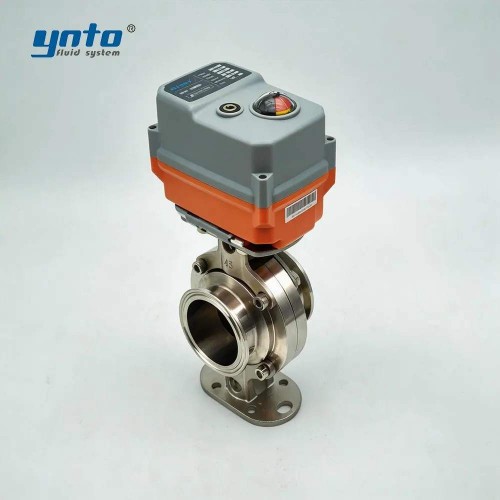
Closing Time: A Crucial Performance Metric
How to Measure Valve Closing Time Effectively
Closing time is the interval required for the actuator to move the butterfly disc from its open position to the required closed position.
That figure should be measured under actual operating conditions, not assumed from an unloaded actuator test.
The torque required to move a valve depends on seat friction, line pressure, deposits, disc size and process conditions. An actuator that appears fast and smooth on a workshop bench may behave differently after the valve has remained stationary in wastewater service for several months.
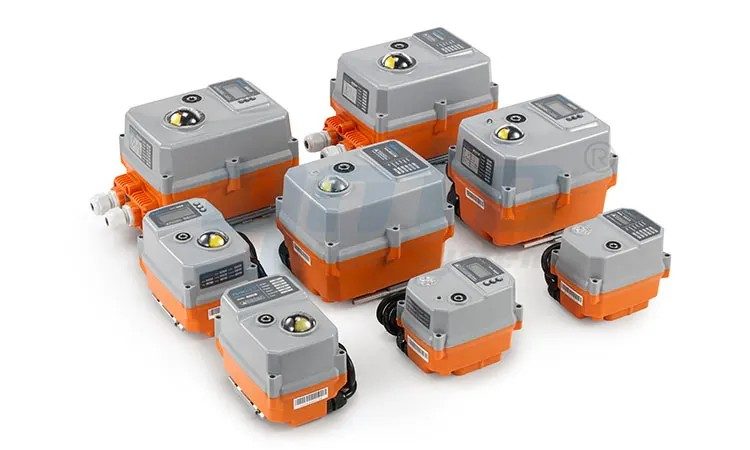
When specifying a retrofit, engineers can compare the valve torque requirement with the available output of the selected electric valve actuator. Adequate torque margin is important, but oversizing the actuator excessively is not a substitute for correcting mechanical or seat problems.
Influence on Hydraulic System Operations
In a pressurized water or wastewater pipeline, closing time directly affects transient behavior.
A rapidly moving disc reduces the available flow area. Water velocity decreases, momentum changes, and a pressure wave can travel through the piping system. If the change is sufficiently abrupt, the resulting transient may appear as water hammer.
The cause-and-effect chain can be easy to miss: an actuator is changed for faster operation, the valve now closes more rapidly, the flow decelerates more sharply, and the pipeline experiences higher pressure transients.
That can affect more than the valve. Flange joints, supports, check valves, pumps and instrumentation can all experience the resulting hydraulic load.
A longer closing time is not automatically better either. Emergency isolation may require a defined response period. The correct closing profile balances process safety with hydraulic stability.
Strategies for Reducing Closing Time Impact
Where pressure transients are a concern, the actuator and control logic can be configured so that the valve does not simply travel from 100% open to 0% open as quickly as possible.
Some systems use staged or controlled closing. Others coordinate the valve with pump shutdown or variable-frequency-drive deceleration. The appropriate method depends on pipeline length, flow velocity, pipe elasticity, static head and process risk.
For significant systems, transient analysis is preferable to guessing.
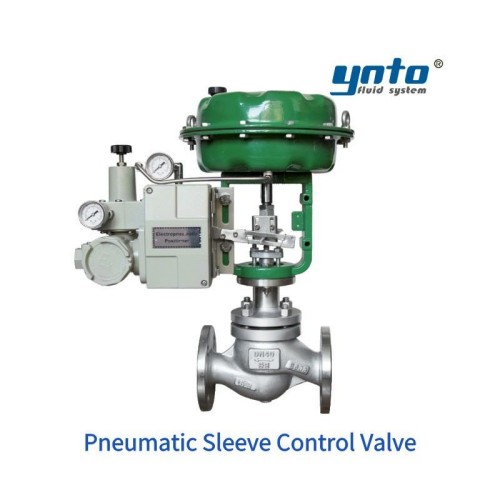
Engineers should also distinguish between an isolation butterfly valve and a dedicated control valve. If the process requires frequent, accurate modulation under variable pressure conditions, YNTO's broader industrial control valve range provides another technology path to evaluate rather than forcing every regulating duty onto a butterfly valve.
Retrofitting for Enhanced Waste Management Solutions
Steps for Retrofitting Existing Systems with PN16 Valves
A successful retrofit starts with the old valve still installed.
Record its face-to-face dimension, connection type, flange standard, shaft orientation, pipe diameter, actuator mounting dimensions and available clearance. Then collect operating pressure, maximum temperature, normal and peak flow, medium composition, solids content and required closing time.
The old valve should also be inspected after removal. Seat deformation, uneven disc wear, corrosion or heavy deposits often explain problems that were not obvious during operation.
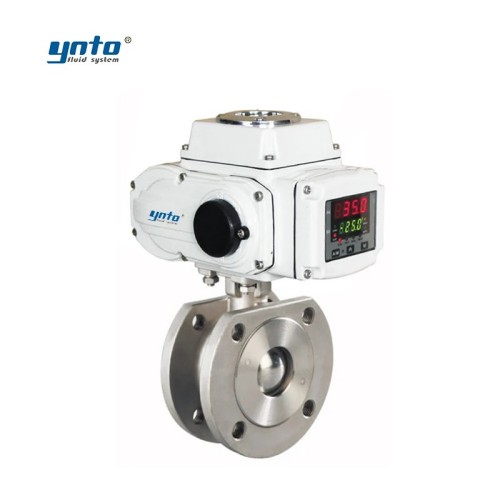
If the valve body remains mechanically suitable and only automation is being upgraded, actuator retrofit may be possible. Industry guidance for actuator retrofit emphasizes checking stem dimensions, available mounting space, torque requirements, brackets, alignment and control integration before assuming that an existing manual valve can simply accept a motorized operator.
For a complete PN16 valve replacement, face-to-face dimension and flange compatibility deserve particular attention because changing them can turn a valve purchase into a piping-modification project.
Benefits for Industrial Automation and Environmental Compliance
Modernizing manual or unreliable valves can improve repeatability across a wastewater facility.
A PLC can coordinate valves with pumps, level instruments and process sequences. Position feedback can confirm whether an isolation command was actually completed. Alarm logic can identify abnormal travel time or failure to reach an end position.
These capabilities support environmental compliance because operators have better visibility into process status.
Yet automation does not remove mechanical fundamentals. If the seat material is chemically incompatible, no communication protocol will prevent degradation. If the valve is oversized for throttling, more precise electronic positioning cannot completely correct an unsuitable hydraulic characteristic.
Hardware and control strategy must agree.
Best Practices for Installation and Maintenance
Before work begins, the pipeline must be isolated, depressurized and drained or flushed according to plant procedures. Lockout/tagout requirements should cover both the process equipment and the actuator power supply.
Residual pressure deserves particular attention in wastewater and chemical systems. A closed upstream valve does not prove that the section being serviced is safe.
During installation, pipe flanges should be aligned rather than pulled together through the valve. Uneven mechanical loading can distort the body or seat. The disc must have sufficient clearance to rotate without contacting adjacent pipework or an incompatible flange bore.
After installation, commissioning should include full-stroke operation, position indication, limit-switch verification, leakage checks and testing with the real control system.
Maintenance teams should then watch trends rather than wait for failure. Increasing travel time, rising current draw, repeated overload alarms or a gradual change in closing position can indicate increasing torque before the actuator stops altogether.
Standards also need to be handled carefully. Depending on project location and specification, ANSI/ASME conventions may determine piping interfaces and pressure classes, while API requirements such as those applied to butterfly-valve design or testing can appear in industrial projects. ISO requirements, including actuator-interface standards such as ISO 5211, can influence interchangeability. DIN and related EN dimensional or pressure standards are common in European systems.
A buyer should state the exact required standard and edition in the purchase specification rather than assuming that the words “PN16 industrial valve” define every dimensional, testing and certification requirement.
For wastewater retrofits, that discipline is important. The valve sits at the intersection of mechanical engineering, fluid dynamics, industrial automation and plant safety.
Get the sizing right and the valve operates in a stable region. Match the seat to the chemistry and torque remains predictable. Control the closing time and hydraulic systems experience fewer unnecessary pressure shocks. Combine those decisions correctly, and a PN16 electric butterfly valve becomes more than a replacement component—it becomes part of a more reliable waste management solution.

- 2026-10-16 10:48:59
- 2026-10-15 14:23:43
- 2026-10-12 15:56:29